
| Question | Working answer | Planning use |
|---|---|---|
| Definition | The values, belief systems, attitudes and assumptions shared by everyone in the workplace | Separate culture from perks and slogans. Ask what people actually believe and do. |
| Existence | Every organization has a culture, whether formally acknowledged or not, and leadership generally dictates it | Examine leader behaviour before launching any program. |
| Payoff | Higher engagement, satisfaction and retention. Voluntary turnover drops significantly when people love the culture | Track engagement and voluntary turnover as the observable outcomes. |
| Characteristics | Seven traits: open communication, empathy, collaboration, development, flexibility, recognition and inclusion | Pick the weakest trait to work on first instead of tackling everything together. |
| Change | Culture can be changed, but it takes work and time and requires everyone in the company | Plan for sustained effort that starts with leaders, not a one-off event. |
The definitions and effects in this table come from a workplace culture overview and a workplace culture fundamentals guide.
What is workplace culture? It is the shared values, belief systems, attitudes and assumptions of everyone in a workplace. It exists whether or not anyone names it, so measure it through outcomes such as engagement and retention.
This guide is the starting point for the rest of the topic. Readers comparing styles can move on to the types of workplace culture, and readers who want concrete cases can browse workplace culture examples. The sections below keep a practical thread throughout: every culture practice is tied to something that can be observed, so progress is checked rather than assumed.
Defining workplace culture
Workplace culture is made up of all the values, belief systems, attitudes and assumptions shared by everyone in the workplace, according to this workplace culture overview. The definition is wide on purpose. It covers what is written down, and it also covers what people quietly expect of one another when nobody is watching.
Workplace culture meaning in practice
The meaning becomes useful when it is turned into questions. What do people here believe a good day at work looks like? What attitudes are assumed when a mistake happens? Which assumptions go unspoken but still shape decisions? Each answer describes culture more accurately than a mission statement does. A team that writes down one set of values but behaves according to another has two cultures, and the lived one is the one that counts.
Organizational culture and workplace culture
The two terms are often used interchangeably, and this guide treats them as the same thing for practical purposes: the shared values, beliefs, attitudes and assumptions of the people in an organization. Where a distinction helps, organizational culture is the usual phrase for the company-wide picture, and workplace culture is the natural phrase when the talk is about the day-to-day experience of a team or site. Readers who want the academic side can follow the main organizational culture models, which describe culture in structured ways.
Culture exists with or without a plan
According to a workplace culture fundamentals guide, every organization has a culture, whether formally acknowledged or not, and it is generally dictated by the leadership. The practical consequence is that “we do not have a culture” is never a true starting position. The real choice is between shaping the culture deliberately and letting it form by default. Organizations that have never discussed their culture still have one, and it is worth describing honestly before trying to change anything.
What culture is not
Culture is not a poster, a perk or a single event. Those can express or support culture, but they are not the culture itself. A useful test is whether a practice changes what people believe and do day to day. If it does not, it is decoration. The measurement approach later in this guide is designed to expose that gap.
Why workplace culture matters
Workplace culture matters because it is linked to outcomes organizations already track: engagement, satisfaction and retention. The fundamentals guide describes a good culture as one that can lead to higher employee satisfaction, engagement and retention. That makes culture a business concern as well as a people concern, and it explains why the topic deserves measurement and not only good intentions.
Engagement and belonging
A strong workplace culture can lead to higher levels of employee engagement, as the overview explains, through a sense of belonging and belief in the work. Belonging and belief are the two ingredients worth watching. People who feel they belong and who believe in what the team is doing are the ones most likely to show up as engaged. The deeper link is covered in employee engagement and culture.
Retention and voluntary turnover
The overview also states that when people love the culture, voluntary turnover drops significantly. Two conditions are built into that statement. The effect depends on people actually valuing the culture, and it applies to voluntary departures, not to every exit. For planning, that makes voluntary turnover the cleanest outcome to follow when asking whether a culture effort is working. A rise should prompt questions about the culture, and a fall is encouraging only if engagement is moving in the same direction.
Satisfaction and accountability
Openness and commitment to each other and to common goals deliver several benefits, including greater employee engagement, accountability and work satisfaction, according to the same fundamentals guide. Accountability is the benefit most often overlooked. It suggests that a healthy culture helps people own their work and follow through, which managers can see in how commitments are handled. Satisfaction can be asked about directly. Accountability is usually visible in behaviour.
Measuring culture through outcomes
The most reliable way to judge a culture is to pick a few observable outcomes first and then link every practice to one of them. Starting with outcomes prevents the common trap of running culture activities that feel good but cannot be evaluated. The core outcomes supported here are engagement, satisfaction, retention and voluntary turnover.

Pick the outcomes before the practices
Decide which of the supported outcomes matters most right now. A team worried about people leaving should follow voluntary turnover. A team worried about energy and commitment should follow engagement. Starting from the outcome makes it easier to choose practices, and it makes later review honest. For a fuller method, see how to measure company culture, and for question wording see culture survey questions for employees.
Practice-to-outcome map
The table links practices named in the supporting guidance to the outcome worth watching. The right-hand column lists what to monitor. It does not promise a result, and each practice should be checked against local data.
| Practice | Outcome to watch | Planning use |
|---|---|---|
| Open communication and a voice for everyone | Whether people raise concerns and ideas without fear; engagement | Check participation in meetings and survey comments before adding new channels. |
| Visible core values | Whether people refer to the values when making decisions | Display values where people work, then listen for them in everyday talk. |
| Leaders mentoring, training and coaching new hires | How new employees settle in; retention | Give leaders a defined part in onboarding instead of leaving it to chance. |
| Recognition | Engagement and work satisfaction | Compare engagement results in teams that recognize contributions and in those that do not. |
| Leadership quality and avoiding micro-management | Voluntary turnover and engagement | Treat a worsening trend as a prompt to review management behaviour first. |
| Development and flexibility | Satisfaction and retention | Ask what support people want before introducing new programs. |
The practices come from the fundamentals guide and the overview, while the outcomes to watch follow their engagement, satisfaction and turnover findings.
Reading the results
One data point means little. Compare the same measure over time and across teams, and read the numbers beside what people say in their own words. A good result in one outcome and a poor result in another is itself informative. For example, strong engagement alongside rising voluntary turnover points to a problem outside the day-to-day team experience, and that is a cue to look at leadership and development rather than at activities.

Core values as a shared reference
Core values are the written statement of what a workplace says it stands for, and they only shape culture when people use them. The fundamentals guide advises visibly displaying company values in offices, on company merchandise, on the website and across social media channels. Visibility keeps values in front of people, but it is a starting step, not proof that the values are lived.
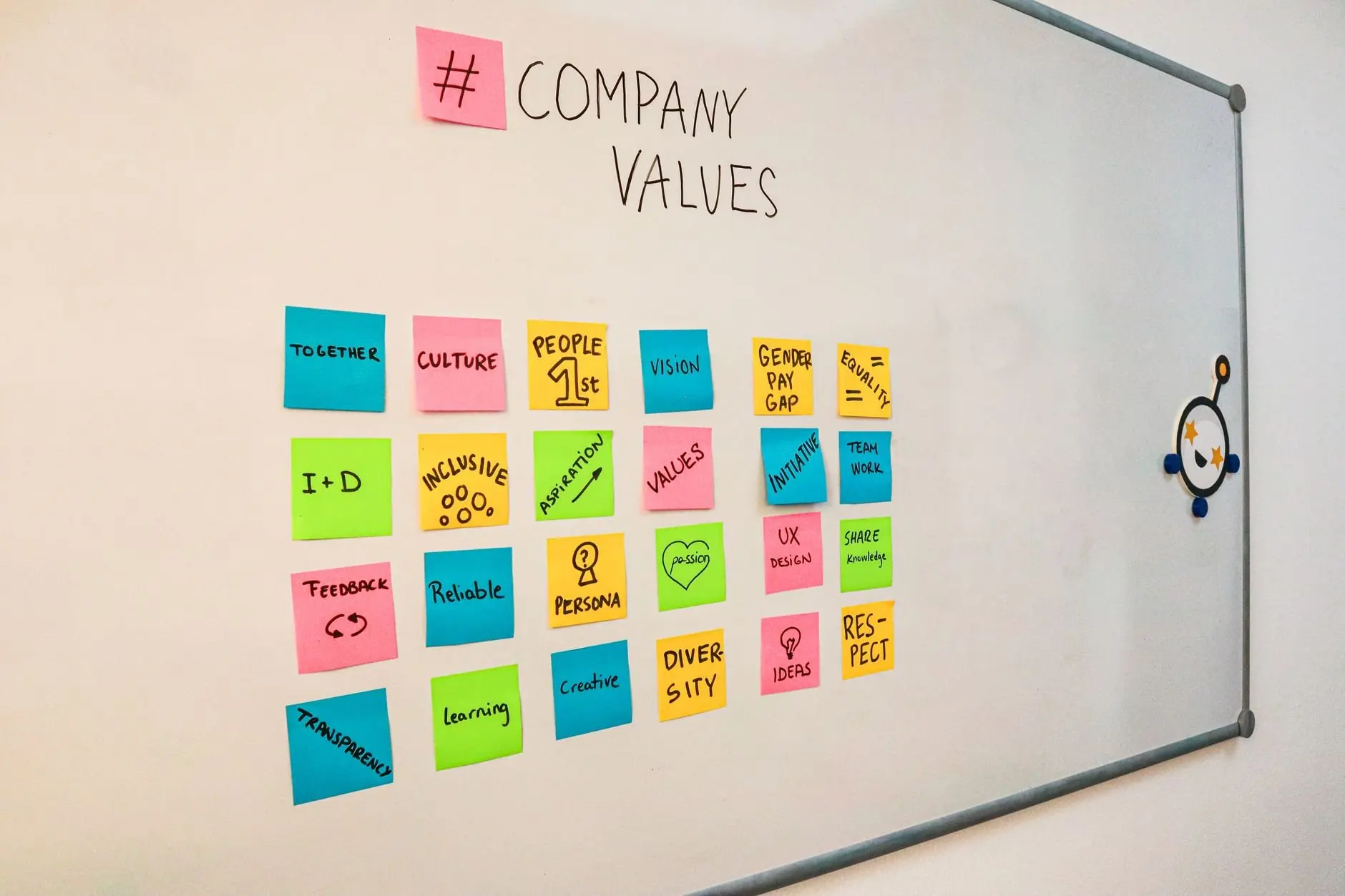
Define values together
Values written by a few people and announced to everyone tend to be the hardest to adopt. Culture is described as shared by everyone in the workplace, so it makes sense to invite everyone into the conversation about values. A whiteboard session, as in the image above, is a low-cost way to start, and a facilitated company culture workshop can add structure for larger groups.
Display values where people see them
Placing values in offices, on merchandise and in digital channels signals that they are meant to be used. The point of display is consistency: new hires, existing staff and outsiders should hear the same message. The check that follows is simple. Ask whether decisions and conversations refer back to those values. If they do not, the display is working as decoration only, and the values need to be discussed again.
Match values to behaviour
A value is only credible when leaders act on it. The overview warns that micro-management or poor leadership can quickly drag even a positive culture down. A value such as trust therefore means little where managers watch every move. When behaviour and values disagree, people believe the behaviour. That is why leader conduct belongs in any values discussion.
Characteristics of a strong workplace culture
The fundamentals guide lists seven key characteristics of a good workplace culture. They form a practical checklist for deciding where to focus. For a fuller look at each, see what makes a good workplace culture.
- Open communication. People share information, concerns and ideas in both directions. The open communication culture guide covers this trait in more depth.
- Empathy. People consider how decisions and words land with colleagues. It is hardest to see in meetings and easiest to see in how difficult news is handled.
- Collaboration. Work is shared across roles and teams. Watch whether people ask each other for help or hold information close.
- Development. People are supported to grow. Look at whether learning is encouraged or only tolerated.
- Flexibility. The workplace adapts to the way people work. It matters particularly for hybrid and distributed teams.
- Recognition. Contributions are noticed and acknowledged. Explore this further through employee recognition culture.
- Inclusion. People of different backgrounds are welcomed and heard. It overlaps strongly with voice, covered next.
Choosing where to start
Working on all seven at once usually spreads effort too thin. Choose the trait that connects to the outcome causing the most concern. If people are leaving, recognition, development and flexibility are natural candidates. If engagement is low, open communication and collaboration are logical first steps. A trait that already feels strong needs maintenance, not a new program.
Psychological safety and voice
Psychological safety is visible in a simple sign: everyone has a voice and is not afraid to use it, as the overview puts it among the marks of a healthy culture. This is the clearest practical test of whether open communication and inclusion are real. To go further, see what is psychological safety at work.
Observable signs
Signs of a workplace where people have a voice include questions asked openly, disagreement raised without worry, and mistakes mentioned early. Quiet meetings where the same few people always speak are a sign worth investigating. Silence can mean agreement, but it can also mean people have learned that speaking up is not worth it.
Who owns it
Leaders set the tone, since the fundamentals guide says leadership generally dictates culture. A manager who thanks people for raising problems makes it easier for others to do the same. A manager who reacts badly makes silence the sensible choice. The measurement link is straightforward: voice shows up in engagement responses, and in whether issues surface early instead of through resignations.
Leadership and onboarding
Leadership is the strongest lever on culture, and onboarding is the point where leaders can show the culture to new people. The overview says micro-management or poor leadership can quickly drag even a positive culture down, and the fundamentals guide advises leaders to become active and involved in onboarding, including mentoring, training and coaching new employees.
Why onboarding carries culture
New employees arrive without the shared assumptions that long-serving staff take for granted. Onboarding is where those assumptions are first learned, from what is said and from what is seen. Leaders who mentor, train and coach in person are teaching the culture by example. Leaving onboarding entirely to paperwork leaves new people to guess at the values from whatever they happen to observe.
Leader behaviour as the baseline
Before launching a culture program, leaders should look at their own behaviour. Micro-management is named as a specific risk. A leader who wants people to take initiative but checks every detail sends two messages, and people follow the second. A practical start is for leaders to ask their teams what they do that helps or hinders, and then to act on a single answer visibly.
Hiring for the culture
Hiring brings new beliefs and assumptions into a workplace, so it is part of culture work. Whether to seek people who match the current culture or people who extend it is a genuine decision, explored in culture fit vs culture add. Whichever way a team leans, the onboarding conversation should state plainly what the culture is.
Everyday rituals and distributed teams
Culture lives in ordinary moments as much as in formal programs. Shared meals, regular check-ins and team calls are places where the characteristics above either appear or do not. The guidance in the supporting sources is about traits and leadership, so the advice here is a judgement about where those traits can be observed.

Informal bonding
Informal gatherings give people a chance to know one another outside their job titles. They suit teams where collaboration and empathy are the traits to strengthen. Inclusion matters here. A ritual that only suits some people, for example one tied to a single time of day or one that excludes part-time or remote staff, can work against the culture it was meant to support. Invite broadly and vary the format.
Remote and hybrid teams
Flexibility is one of the seven characteristics, and it is central to distributed teams. Culture still means shared values, beliefs, attitudes and assumptions, whether people share a building or not. What changes is where those assumptions become visible. On a video call, the question is whether everyone has a voice and is not afraid to use it, not simply whether the call is scheduled.

Checking remote participation
Watch who contributes on calls and who rarely does. If the same people dominate, ask whether the format is the problem. Smaller discussions, written input before meetings and deliberate invitations to quieter members are all ways to give everyone a voice. Track the results through the same engagement outcomes used elsewhere, so remote and in-person experiences can be compared.
Feedback and recognition
Feedback and recognition turn the traits of recognition, development and open communication into regular habits. They are among the most direct places where a manager can influence culture, because they happen in conversations that managers already hold.

One-on-one conversations
A private conversation between a manager and an employee is the simplest forum for both feedback and thanks. It supports development, since people learn where they stand, and it supports voice, since people can raise concerns in a lower-pressure setting. Managers who use these conversations well often find they surface issues long before a survey would.
Recognition that fits the person
Recognition is one of the seven characteristics, and the greatest benefit comes when it is specific and genuine. Generic praise adds little. Naming what someone did and why it mattered shows that the contribution was noticed. The engagement and satisfaction outcomes described earlier are the right places to check whether recognition is landing, because those are the benefits attributed to a positive culture.
Changing company culture
Workplace culture can be changed, but the overview is clear that it takes work and requires everyone in the company. That is both encouraging and demanding. It is encouraging because culture is not fixed. It is demanding because a short campaign will not do. Leadership behaviour is the natural place to start, since leadership generally dictates culture.
A sensible order of work
- Describe the current culture honestly. Gather views from across the organization, not only from leaders.
- Choose the outcome to improve. Engagement, satisfaction, retention and voluntary turnover are the supported measures.
- Start with leader behaviour. Leaders model the change before asking others to adopt it, including how they handle onboarding.
- Involve everyone. Invite people into defining values and spotting obstacles.
- Review on a schedule. Re-measure the chosen outcome and adjust what is not working.
Where to read next
The step-by-step approach is set out in how to improve workplace culture, and a structured sequence for larger efforts appears in the culture change plan. Smaller teams can usually begin with the first three steps above and expand later.
Patience and realistic expectations
Because culture is built from shared assumptions, it moves more slowly than policies do. A change in a policy can be announced in a day, but a change in belief takes repeated evidence that things are different. Expect early signals in voice and everyday behaviour, and expect the retention picture to follow rather than lead.
Warning signs to act on
A culture that is working against people usually shows it before long. Poor leadership and micro-management can quickly drag even a positive culture down, according to the overview, so these are the first behaviours to review. A full checklist is available in signs of a toxic workplace.
Signals worth checking early
- Silence where voice should be. If people no longer speak up, the healthy-culture sign of everyone having a voice is missing.
- Rising voluntary turnover. Because voluntary turnover drops significantly where people love the culture, a rise is a reason to investigate.
- Falling engagement. Engagement is closely linked to belonging and belief in the work, so declines point to those two areas.
- Control over trust. Micro-management is a named risk, so look at how much managers check and how much they let go.
How to respond
Start with a conversation, not a program. Ask people what they are seeing, listen without defending, and pick one change to try. Return to the outcome measure afterwards. If the signal improves, continue. If it does not, the cause may sit with leadership behaviour rather than with the activity just tried.
Where to start
The right first step depends on what is prompting the question. These starting points suit different situations.
- Learning the basics. Begin with the definition and the seven characteristics, then choose one trait to examine in the team.
- Worried about people leaving. Track voluntary turnover and review leadership behaviour, recognition and development first.
- Concerned about energy and commitment. Follow engagement, and look at belonging, belief in the work and voice.
- Preparing to hire or onboard. Involve leaders in mentoring, training and coaching, and state the values plainly.
- Planning a larger change. Accept that it takes time and the involvement of everyone, and begin with leaders.
Whichever route is chosen, keep the measurement-first habit: name the outcome, make one change, and check again.
Frequently asked questions
How do you change company culture?
Treat it as sustained work that involves the whole company, led by visible changes in what leaders do. The overview notes that culture can be changed but requires time and effort from everyone.
What are examples of strong workplace culture?
Strong cultures show the seven characteristics in daily practice, such as people having a voice, contributions being recognized and development being supported. Everyday behaviour is the better evidence, not a list of values on a wall.
How does culture affect retention?
A good culture is linked to higher satisfaction, engagement and retention, and the overview states that voluntary turnover drops significantly when people love the culture. That makes voluntary turnover a useful measure to follow.